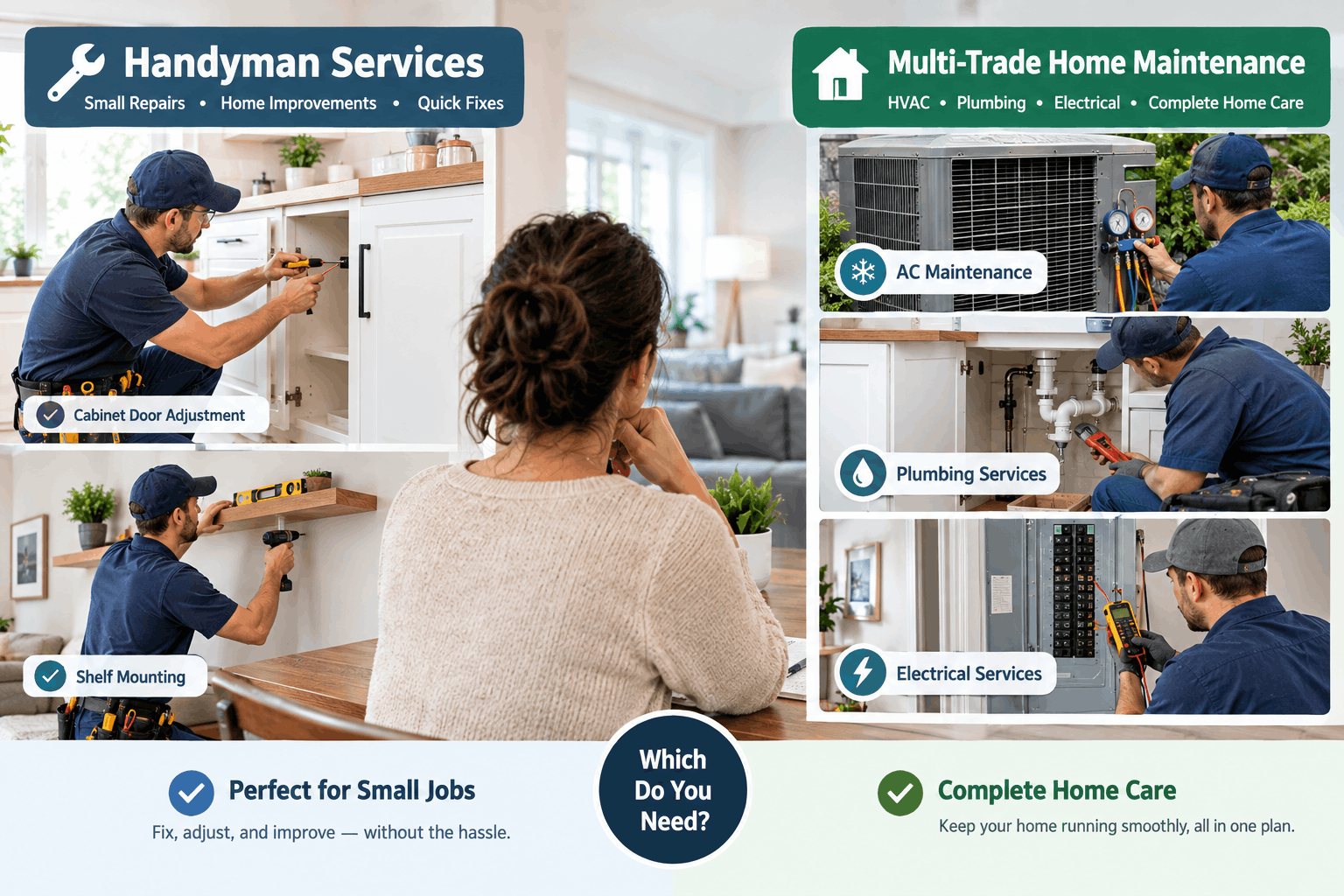
Choosing between a handyman vs home maintenance service depends mainly on the type, complexity, and number of jobs that need attention. A handyman is often suitable for general minor repairs and practical household tasks, while broader home maintenance may involve several repair categories or specialist professionals such as plumbers, electricians, and AC technicians.
The terms can sometimes overlap, which makes the choice confusing. Instead of focusing only on the service label, look at the actual work involved and whether it requires general practical skills or specialist technical expertise.
What Does a Handyman Typically Do?
A handyman generally handles smaller household jobs that do not require a specialist trade or technical diagnosis.
The exact services offered vary between professionals, but common handyman tasks can include:
- Adjusting doors and cabinet hinges
- Installing shelves
- Assembling furniture
- Mounting household items
- Replacing simple non-technical fixtures
- Performing minor carpentry work
- Handling small cosmetic repairs
- Completing several basic jobs during one visit
A handyman can be especially practical when a household has accumulated a list of relatively straightforward tasks.
For example, if you need a shelf mounted, a loose cabinet door adjusted, and a damaged handle replaced, one general service professional may be able to handle the entire list.
What Is a Home Maintenance Service?
Home maintenance is a broader concept covering the ongoing repair, servicing, and upkeep of a residential property.
It can include general handyman work, but it may also involve distinct service categories such as:
- Air-conditioning maintenance and repair
- Plumbing
- Electrical work
- Carpentry
- Painting
- Appliance repair
- General household repairs
- Preventive property maintenance
Therefore, home maintenance does not necessarily describe one technician who performs every task.
Instead, it can describe a wider approach to keeping a property functional by directing different problems to professionals with suitable skills.
Handyman vs Home Maintenance Service: What Is the Main Difference?
The simplest difference is scope.
A handyman is generally associated with smaller, non-specialist jobs. Home maintenance can cover a wider range of property needs, including tasks that require specific technical expertise.
Consider a homeowner with four problems:
- A loose bedroom door handle
- A cabinet that no longer closes correctly
- An AC unit that has stopped cooling
- A circuit breaker that repeatedly trips
The first two may fit a general handyman’s capabilities.
The AC problem should normally be assessed by someone with relevant cooling-system expertise, while a recurring electrical fault should be directed to an appropriately qualified electrical professional.
Calling every problem a “handyman job” can therefore make it harder to choose the right person.
When Is a Handyman the Better Fit?
A handyman makes sense when the work consists mainly of straightforward household tasks that can reasonably be grouped together.
For instance, you might have several small jobs after moving into a property: furniture needs assembly, a shelf needs mounting, a door requires adjustment, and a few fittings need attention.
Instead of arranging separate visits for every minor task, grouping compatible work can be more practical.
Before booking, clearly describe each job. This gives the professional an opportunity to confirm whether the full list fits within their services.
When Do You Need Broader Home Maintenance Support?
Broader maintenance support becomes more relevant when your repair list crosses several service categories.
For example, a property might simultaneously have:
- Weak AC cooling
- A leaking bathroom fixture
- A damaged cabinet hinge
- An electrical socket that is not working normally
These problems may require different skills rather than one general worker.
In situations like this, a multi-category platform for Dubai home services can help residents approach several household repair needs without assuming that every problem belongs to the same trade. The useful distinction is matching each task with an appropriate type of professional.
Which Jobs Should Not Automatically Go to a Handyman?
A task should not be treated as general handyman work merely because it happens inside a home.
Technical problems can require specific knowledge, equipment, or qualifications.
Electrical Faults
Problems involving fixed wiring, electrical panels, repeated breaker trips, or other technical electrical faults should be directed to an appropriately qualified professional.
AC Problems
If an AC system is not cooling, leaks repeatedly, develops unusual operating problems, or requires internal diagnosis, an AC technician is more appropriate than a general handyman.
Plumbing Faults
Minor visible issues may initially appear straightforward, but persistent leaks, concealed water problems, damaged pipes, or recurring drainage faults can require a plumber.
The underlying principle is simple: choose based on the work, not merely the convenience of assigning everything to one person.
What If You Have Several Small Repairs?
Start by making one complete repair list.
Then separate the jobs into categories such as:
General tasks: shelves, handles, furniture assembly, doors, cabinets, and simple fittings.
Plumbing: leaks, drainage problems, taps, toilets, and water-related faults.
Electrical: sockets, switches, breakers, wiring, and recurring power problems.
AC: cooling performance, airflow problems, leaks from AC equipment, and technical servicing.
Carpentry: repairs or modifications involving woodwork, doors, cabinets, or fitted furniture where more specific skills may be needed.
This simple classification can prevent an unsuitable booking and makes it easier to explain the scope of work.
Can One Professional Handle Everything?
Sometimes one professional can complete several related tasks, but you should not assume that one person is suitable for every category.
The more varied the repair list becomes, the more important it is to distinguish general maintenance from specialist work.
A useful service request should therefore describe the actual problems rather than simply asking for “someone to fix everything.”
Photos can also provide useful context for visible defects. For technical problems, describe symptoms accurately without trying to diagnose the cause yourself.
Is Home Maintenance Only for Major Repairs?
No. Home maintenance includes both small and substantial tasks.
The difference is that maintenance looks at the needs of the property more broadly. It may involve routine upkeep, minor repairs, specialist servicing, or addressing faults as they appear.
For example, adjusting a door is maintenance. Servicing an AC system is also maintenance. Repairing a plumbing leak can form part of property maintenance as well.
However, those tasks do not necessarily require the same professional.
Understanding this distinction helps homeowners organize repairs more effectively.
Choose According to the Job, Not the Label
The handyman vs home maintenance service decision becomes easier when you focus on the actual work required.
For a short list of straightforward household tasks, a handyman may be the practical choice. When problems involve AC, plumbing, electrical systems, or several different categories, broader maintenance support and specialist professionals may be more appropriate.
Create a clear repair list, separate general tasks from technical faults, and describe each problem accurately. This approach makes it easier to match household maintenance needs with the right skills instead of expecting one service type to cover every possible repair.