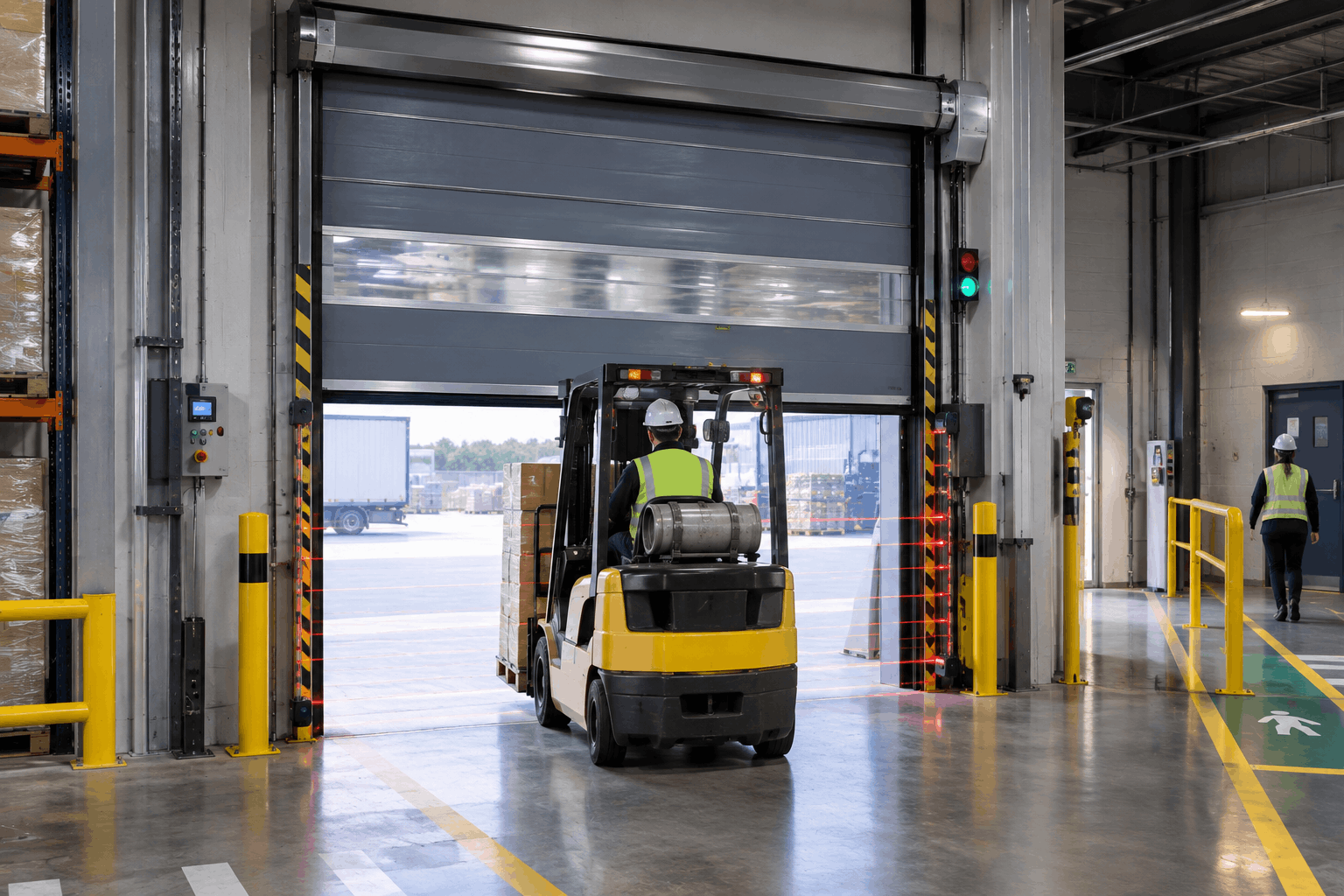
Automated door safety features help industrial facilities manage vehicle and pedestrian movement while reducing the risks associated with powered doors. In warehouses, factories, loading areas, and production facilities, an automated entrance may operate repeatedly throughout the day, making detection, control, and emergency protection important parts of the overall system.
The right safety configuration depends on the door design, traffic pattern, opening size, operating environment, and people or vehicles using the entrance. A forklift-only entrance may need different controls from an area shared by forklifts, workers, and pedestrians.
Why Safety Matters With Automated Industrial Doors
An automated industrial door moves without a person manually operating it each time. That improves convenience and can support efficient traffic flow, but it also means the system needs appropriate ways to detect people and objects.
A complete safety approach can include:
- Presence and movement detection
- Photoelectric sensors
- Light curtains
- Safety edges
- Emergency stop controls
- Warning devices
- Access-control systems
- Appropriate opening and closing logic
These components can work together to help the door respond to its surroundings.
Key Automated Door Safety Features
Photoelectric Sensors
Photoelectric sensors use a light beam to detect an interruption. Depending on the system configuration, they can help detect an object or person within a defined area.
They are commonly considered when an automated door needs to recognize traffic passing through or approaching the entrance.
Sensor positioning matters. The detection area should correspond to the actual movement around the door rather than being selected without considering the site layout.
Light Curtains
A light curtain creates a detection zone using multiple beams. This can provide broader coverage than a single beam and may be useful where people or equipment can occupy different positions within the opening.
For example, a facility with mixed pedestrian and forklift traffic may need a more comprehensive detection arrangement than an entrance used only by vehicles.
Safety Edges
A safety edge can provide another layer of protection by responding when contact occurs at a designated part of the moving door system.
The exact function and application depend on the door design. Safety edges should be selected as part of the complete control and protection system rather than treated as a substitute for other detection methods.
Radar and Motion Detection
Radar-based detection can identify approaching movement and trigger an automated door according to the configured control logic.
This can be useful at vehicle entrances where forklifts or other industrial traffic need hands-free access. The detection zone should be configured carefully so that the door responds to intended traffic without unnecessary activations.
Emergency Controls
Automated doors should also have appropriate emergency controls for the facility and door type. Depending on the installation, this may include emergency stop functions, manual operation arrangements, or other procedures for handling a power or control-system interruption.
The specific requirements should be established during system design and installation.
How Should Sensors Be Selected?
Sensor selection starts with understanding who and what uses the entrance.
Consider:
Vehicle type: Forklifts, trucks, AGVs, and other vehicles may approach from different heights and directions.
Pedestrian movement: If workers share the same area, pedestrian detection and separation may require additional planning.
Traffic direction: A one-way entrance can have different detection requirements from a two-way opening.
Operating speed: Faster door movement requires appropriately configured detection and safety controls.
Environmental conditions: Dust, lighting, temperature, moisture, and other conditions can affect how certain sensors operate.
A safety system should therefore be designed around the actual environment rather than simply adding the largest possible number of devices.
Safety and Access Control Serve Different Purposes
Access control determines who or what is authorized to use an entrance, while safety systems help detect conditions that require the door to respond or stop according to its configuration.
For example, an access-control system might permit authorized personnel to open a restricted industrial entrance. A photoelectric sensor or light curtain can perform a different role by detecting movement or obstruction around the door.
Using both systems can be appropriate when a facility needs controlled access as well as automated movement protection.
Choosing the Right Automated Industrial Door
Safety equipment should not be selected separately from the door itself. The construction, operating speed, cycle frequency, dimensions, control system, and intended environment all influence the appropriate configuration.
For example, a busy manufacturing entrance may need a high-speed door with automated activation, vehicle detection, and multiple safety measures. A smaller internal opening with limited traffic may have different requirements.
Facilities researching automated industrial doors should therefore review the available safety and control configurations alongside the door’s physical and operational specifications.
What About Forklift and Pedestrian Traffic?
Mixed traffic deserves particular attention because forklifts and pedestrians move differently.
A facility can reduce potential conflicts by separating pedestrian routes from vehicle routes wherever the building layout permits. Door activation should then be coordinated with the traffic pattern.
For example, a warehouse might use dedicated pedestrian access alongside a larger automated vehicle entrance. Sensors can then be positioned according to the movement expected at each opening.
The objective is not simply to make a door open automatically. It is to create predictable movement through the entrance.
Safety During Power or Control Interruptions
Industrial facilities should also consider what happens when normal power or automated control is unavailable.
The appropriate response depends on the door design and installation. Some systems may include manual operating arrangements or specific emergency procedures. These should be understood by facility personnel before the door is placed into routine service.
Operators should know how to respond to an interruption and whom to contact for technical assistance or maintenance.
Common Questions About Automated Door Safety
What is the most important safety feature for an automated industrial door?
There is no single feature that suits every installation. The appropriate combination depends on the door, traffic, environment, and risk conditions. Detection devices, safety edges, emergency controls, and suitable control logic can each serve different functions.
Do automated doors need sensors?
Many automated industrial door applications use sensors or other detection technologies to control activation and provide safety functions. The exact equipment depends on the door system and site requirements.
Can one sensor protect the entire entrance?
Not necessarily. A single sensor may not provide adequate coverage for every traffic pattern or door configuration. The detection area should be evaluated against the movement of vehicles, pedestrians, and equipment.
How often should industrial door safety equipment be checked?
Inspection requirements depend on the equipment, manufacturer recommendations, operating environment, and applicable workplace procedures. Facilities should establish a suitable inspection and maintenance routine rather than waiting for a problem to appear.
Building Safety Into the Door Selection Process
Safety works best when it is considered before installation. Start by identifying the people, vehicles, and equipment that use the entrance. Then evaluate the door’s speed, operating frequency, dimensions, environmental conditions, and automation requirements.
From there, determine which detection and protection technologies fit the application. The final system should provide predictable operation while allowing maintenance personnel to inspect and service the equipment appropriately.
An automated industrial door is part of a larger workplace access system. When sensors, safety controls, access management, traffic routes, and door operation are planned together, facilities can create an entrance that supports efficient movement while addressing the specific safety conditions of the site.